Mental stimulation for dogs: 8 indoor games for bad-weather days
Do dogs get bored? Sometimes. Here are 8 brain games and enrichment activities that tire your dog out when rain, heat, or cold cut the walk short.
Some days the weather wins. A downpour, a heat wave, a wind chill that turns the loop around the block into five minutes by the curb. Your dog still has energy to burn, and you still have a dog staring at you from the couch.
That's where mental stimulation for dogs comes in. Thinking is work. A dog who spends a short session solving problems, sniffing out food, or learning a new trick often settles more deeply than a dog who got a longer walk with nothing to figure out. Below: whether dogs actually get bored, how to tell, and 8 indoor brain games you can start today.
Do dogs get bored?
Probably, in their own way. We can't ask a dog whether an activity satisfies him. We can make a strong guess from what he's doing and from his body language.
When people say a dog is bored, a few other things are often going on:
He's tired, not bored. A dog does ten repetitions of sit-to-down in class and then stops participating. Is he bored? Or is his body done? You don't stop doing push-ups because you're bored.
He's resting, which is normal. Dogs sleep at night and rest a lot during the day. They're most active around dawn and dusk. A behaviorally healthy dog spends much of the workday resting. That isn't boredom. That's being a dog.
He's trained you. A dog wanders the house or barks once. A caring owner checks if he needs to go out, offers water, a chew, or a game. Repeat that a few times and the dog learns that pacing or barking gets attention. For a few weeks, try rewarding the calm moments instead: resting, playing alone, quietly watching you. The reward can be a tossed treat, a smile, or getting up to play.
Every dog's needs for exercise and mental stimulation are different, and they shift across a dog's life.
How to tell if your dog is bored
There's no boredom test. The practical move is to change one thing and watch what happens.
Adjust activity for a week or two. With your veterinarian's OK, try more exercise, different exercise, or more training, and note any change at home. If you usually leash walk, try calling your dog back and forth between two people in a hallway.
Film the barking. If your dog barks while you're out, set up a camera. Barking alone is often separation distress or alerting to sounds outside. Video tells you which, so a trainer can help with the right problem.
Read the destruction. Shredding cardboard or a fringed rug is often fun, not frustration. "Dissecting" is part of a dog's natural predatory sequence. Give that instinct an outlet (game 7 below) and puppy-proof the rest. A crate or pen helps at times too.
Why bad-weather days need a plan
Weather is the most common reason a walk gets cut short. Heat and humidity shrink the comfortable window in summer. Wind, wet, and ice do it in winter. On a day when your dog's Dog Feel° reads CAUTION or HIGH RISK, the move is usually a shorter, purposeful trip outside and a longer session of brain work inside.
Your dog's Dog Feel° tier, not the number on your phone, sets how much of the day happens outside.
OutsideA normal walk.
InsideA game after if he's still wired.
OutsideA shorter, purposeful walk.
InsideMake up the difference with brain games.
OutsideEssential trips only, kept brief.
InsideBrain games carry the day.
If you're unsure where today falls, start with how hot is too hot to walk a dog or how cold is too cold. Then come back here.
8 brain games for dogs you can play indoors
Keep sessions short. A few minutes of focused work, a break, then another round. Stop while your dog still wants more.
Space needed, energy level, and the skill each one builds. Tap a game to jump to it.
1. Spin in a circle
Spin lets your dog wiggle and move without taking up much space. It also builds flexibility and balance.
Hold a treat and let your dog lick it while you guide him forward one step. Release the treat. Repeat, then ask for 2 to 3 steps before releasing. Once he follows well, guide him in a partial circle, then half, then all the way around. If he sits, your hand is too high. Once he is comfortable with the movement, you can start adding in a cue word and slowly reduce his dependence on the treat.
2. Back up
Backing up has real uses: moving your dog away from the coffee table, out of a narrow hallway, or back onto the curb. It's also a strong balance and coordination exercise.
Once your dog is standing, move a treat under his chin toward his collar. Many dogs lean or step back to follow it. Mark and reward. Build to 2 to 3 steps back before the treat. Skip the body pressure: you want him following the treat, not avoiding you.
3. Paws up
Teach your dog to put his front paws on a footstool, box, or sturdy cushion. Great for photos, and handy for checking a belly or clipping on a leash for a shorter dog.
Pick something stable and non-slip. Use a treat or hand touch to guide his front paws up, and reward the instant they land. Feed a few treats one at a time while he stays, then invite him off and repeat. If he's unsure, don't pull him up. Switch to something easier, like a folded dog bed or a flattened cardboard box.
4. Find it (scent games)
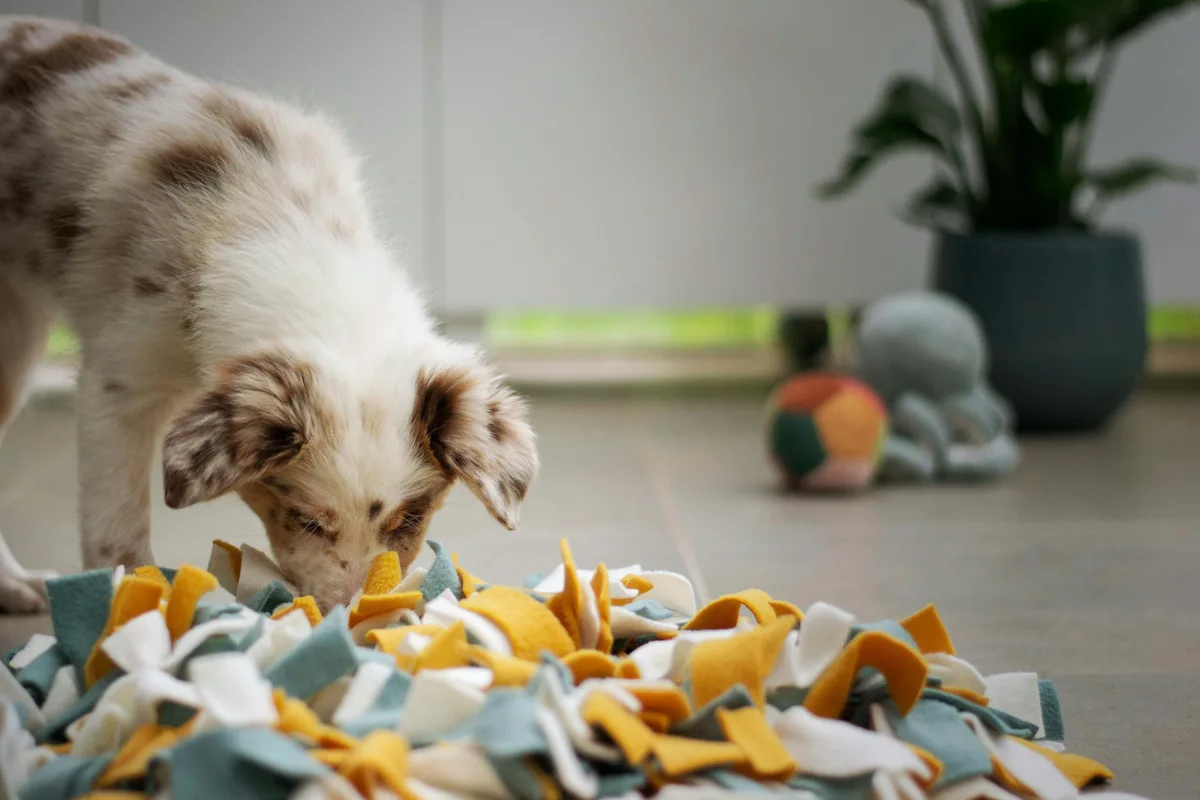
Scent games for dogs tap into the sense dogs rely on most. Toss a treat and say "find it." Then toss two. Then hide treats behind a chair leg while he watches. Graduate to hiding them in another room. A snuffle mat or treats scattered in a towel works the same muscles on a smaller scale.
5. Meals as puzzles
There's no rule that dinner comes from a bowl. Serve part of a meal in a food puzzle toy he has to push or roll. Make it harder by adding a crumpled half-sheet of paper inside, so the kibble has to work around it. Make it easier with smaller food pieces or something lickable on the outside.
For calmer moments, stuff a hollow rubber toy with soaked kibble or canned food and freeze it. Make several at once so they're ready. Supervise with any chew.
6. Hallway recall
Two people, one at each end of a hallway. Take turns calling your dog and rewarding when he arrives. It burns energy, sharpens his come when called, and needs no weather at all.
7. The dissection box
Drop a few treats into a paper bag, fold it closed, and put it in a cardboard box. Let him tear his way in. This gives the shredding instinct a legitimate job. Supervise so he doesn't eat the cardboard.
8. Tug with rules
Tug gets a dog's heart rate up in a small space. Build in structure: he grabs on your cue, lets go on your cue, and the game restarts. A flirt pole (a sturdy pole with a rope and toy at the end) works too. These are interactive toys, not chew toys, so put them away after the game.
How to keep a dog from being bored when home alone
For the most part, dogs should rest when they're home alone. Give yours a quiet rest area. Experiment with how much exercise and brain work he gets before you leave, and watch how he settles. For a long day, a dog walker can break it up for adult dogs. Young puppies need someone to visit a few times a day.
My dog is bored but won't play with toys
Not everyone likes jigsaw puzzles. Some dogs weren't encouraged to play with toys as puppies and have to learn it as adults. Some just don't care for a particular toy. For many dogs, the fun is the person, not the object.
You can meet your dog's needs for sniffing, exploring, moving, and foraging without toys at all. Scatter treats in the grass, hide food around the house, or walk somewhere new on the next decent weather day.
Frequently asked questions
Do dogs get bored? Probably, in their own way, but a lot of what looks like boredom is rest, tiredness, or learned attention-seeking. Dogs naturally rest much of the day. Change one thing, like adding a short training session, and watch whether behavior at home changes.
How can I tell if my dog is bored? Look for patterns rather than single moments. Barking while you're out, destructive chewing, or pacing can point to unmet needs, but they can also mean separation distress or alerting. A camera and a week or two of adjusted activity will tell you more than guessing.
What are easy brain games for dogs? Start with find it, spin, back up, and food puzzles. Each takes a few minutes, works in a small space, and builds on skills your dog already has.
Does mental stimulation tire a dog out? Yes. Short sessions of problem-solving, scent work, or new tricks tire many dogs more than owners expect, which is why they're so useful on days when the weather shortens the walk.
What can I do with my dog on a rainy day? Take a short, purposeful trip outside for the bathroom, then switch to indoor enrichment: scent games, a frozen food toy, hallway recall, or a mini agility course from household items. Dry your dog's coat when you come in.
Can mental stimulation replace a walk? Not entirely. Dogs still need movement, sniffing, and time outside. On days when conditions for your dog read CAUTION or HIGH RISK, brain games fill the gap so a shorter walk doesn't mean a restless dog.
Know when the walk is worth it
Some days the walk is short and the living room does the rest. Create a free account, add your dog, and see her Dog Feel° and tier for right now and for the hours ahead.
Create your free accountHow Pawcast talks about conditions
A note on the words you will see in this post and in the app. Pawcast™ (weather.pet) describes conditions using three tiers: WITHIN RANGE, CAUTION, and HIGH RISK, alongside a Dog Feel° temperature and a Risk Score from 0 to 100. Conditions are also described relative to your dog's personal band: BELOW RANGE, WITHIN RANGE, or ABOVE RANGE. You will not see absolute promises in Pawcast, in either direction: no wording that guarantees a walk will go well, and no wording that a given moment is risk-free. Conditions are always relative to your specific dog, and your judgment on the ground always comes first.
Written by the Pawcast training team. Reviewed by Hilary Jones, DVM, Chief Veterinary Officer at Pawcast.
Pawcast provides estimates to help guide your decisions, not replace them. Your dog's individual health and real-time condition always come first. This article is informational, is provided for educational purposes, and is not a substitute for veterinary care. If you have concerns about your dog, contact your veterinarian.